Emotional Literacy and Wellbeing at Windlesham School
At Windlesham School, children’s emotional wellbeing is a priority and underpins everything we do. We believe that developing emotional literacy is essential for helping pupils feel safe, confident and ready to learn, both in school and beyond.
Through our PSHE curriculum and everyday classroom practice, children are taught to:
• Recognise and name a wide range of emotions
• Understand that all feelings are normal and valid
• Learn practical strategies to manage emotions in positive, healthy ways
• Build resilience, empathy and positive relationships
This work reflects national guidance for PSHE and health education and is informed by research highlighting the importance of emotional regulation in supporting children’s mental health, behaviour and academic engagement.
Ready… Set… Regulate!
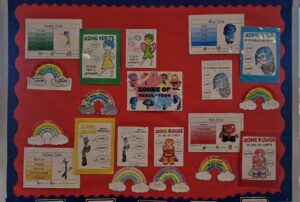
To ensure a consistent approach across the school, the academic year began with a dedicated “Ready, Set, Regulate!” week. During this time, pupils took part in cross-curricular lessons and activities designed to explore emotions, develop shared language and practise regulation strategies.
These activities were woven through reading, writing, discussion, art, movement and reflection, giving children meaningful opportunities to apply emotional learning in different contexts.
The Zones of Regulation
A key framework supporting our approach is the Zones of Regulation, developed by occupational therapist Leah Kuypers. The Zones provide a simple, child-friendly way for pupils to identify how they are feeling and understand how emotions can affect behaviour and learning.
The four Zones are:
• Blue Zone – low energy or low mood (e.g. tired, sad)
• Green Zone – calm, focused and ready to learn
• Yellow Zone – heightened emotions but still in control (e.g. excited, worried)
• Red Zone – intense emotions where self-regulation is more challenging (e.g. anger, panic)
Children are taught that all Zones are normal. The focus is on recognising emotions and choosing appropriate strategies to help regulate themselves.
Parent FAQ: Supporting Emotional Regulation at Home
What have children been learning at school?
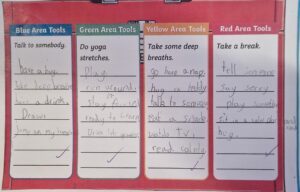
As part of our emotional literacy work, all children created their own self-regulation toolkit. This is a personalised collection of strategies that help them move between different Zones when emotions feel tricky, one is kept at school and a copy was sent home.
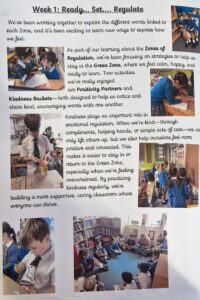
Children explored and identified:
– What different emotions feel like in their bodies
– Which strategies work best for them (e.g. movement, breathing, quiet time, talking, sensory tools)
– That different situations may require different strategies
This supports children to become more independent and reflective in managing their emotions.
Why is emotional regulation important?
Research shows that children who can identify and name their emotions are better able to manage them. Neuroscience research into affect labelling shows that putting feelings into words can reduce emotional intensity and help children feel more in control.
By increasing emotional vocabulary and linking emotions to physical sensations, children are supported to recognise emotions earlier and regulate more effectively.
How can I support this at home?
-
Children benefit when adults model the same language used at school. For example:
– “I’m feeling a bit blue right now — my body feels slow.”
– “I wonder what I could do to help myself?”
– “I’m going to take a deep breath to help me regulate.”
-
Books and stories provide excellent opportunities to explore emotions. You might ask:
– “What Zone do you think this character is in?”
– “How do you know?”
– “What might help them move to a different Zone?”
What if my child is in the Red Zone?
The Red Zone is a normal part of emotional development. Children often need calm adult support. Once settled, revisiting strategies from their toolkit can help them reflect and learn.
Key Messages for Families
• There is no such thing as a ‘bad’ Zone. All emotions are normal and valid.
• Movement between Zones is fluid and happens throughout the day.
• We label behaviour, not the child (e.g. ‘I am in the Red Zone’, not ‘I am red’).
• Avoid rescuing too quickly — allow children time to choose strategies independently.
• Link emotions to body signals to help children recognise feelings early.
• A rich emotional vocabulary supports better regulation and resilience.